PRE-LOVED ★ RELOVED ★ REPEAT ★ SELL YOUR WARDROBE ★ FIND YOUR NEXT FAVOURITE ★ PRE-LOVED ★ RELOVED ★ REPEAT ★ SELL YOUR WARDROBE ★ FIND YOUR NEXT FAVOURITE ★ PRE-LOVED ★ RELOVED ★ REPEAT ★ SELL YOUR WARDROBE ★ FIND YOUR NEXT FAVOURITE ★ PRE-LOVED ★ RELOVED ★ REPEAT ★ SELL YOUR WARDROBE ★ FIND YOUR NEXT FAVOURITE ★ PRE-LOVED ★ RELOVED ★ REPEAT ★ SELL YOUR WARDROBE ★ FIND YOUR NEXT FAVOURITE ★ PRE-LOVED ★ RELOVED ★ REPEAT ★ SELL YOUR WARDROBE ★ FIND YOUR NEXT FAVOURITE ★
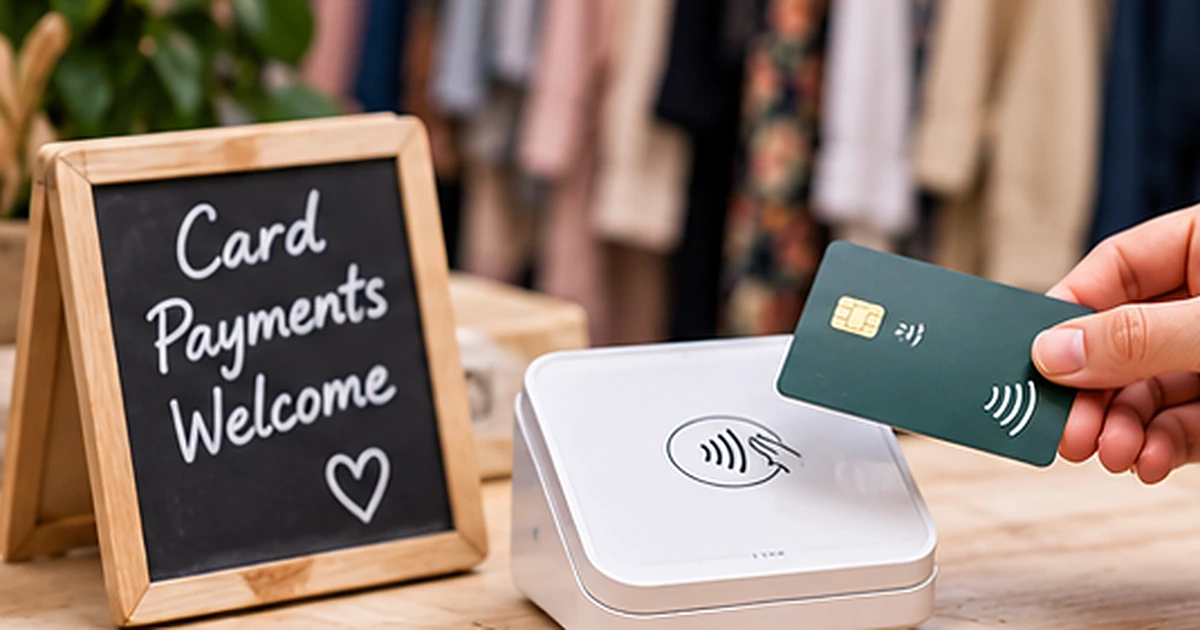
You’ve sorted your clothes, put together a lovely display and worked out your prices. You’re ready to sell.
Then someone finds the perfect jacket, asks how much it is and reaches for their phone.
Hang on. How are they actually going to pay you?
If you’re used to selling clothes through Vinted or eBay, taking payments face to face might be unfamiliar territory. But it doesn’t need to be complicated or expensive.
Whether you’re selling at your first pre-loved fashion market or regularly attending pop-up events, there are several straightforward ways to get paid.
Here’s what you need to know.
1. Cash: The Old Favourite Still Has Its Place
Cash might seem a little old-fashioned, but it’s still a perfectly practical way to sell at a clothing market.
Some shoppers prefer using cash, particularly when they’ve set themselves a budget for the day.
And from a seller’s perspective, it has some obvious advantages.
- No card processing fees.
- No technology to set up.
- No internet connection required.
- You receive the money immediately.
The main thing to remember is that you’ll need change.
Imagine somebody buying an £8 top and handing you a £20 note. If you’ve got nothing smaller, things can become awkward.
How much change should you bring?
For a small clothing stall, a starting float of around £50–£80 in mixed notes and coins may be sensible, depending on your prices and expected sales.
Include plenty of £1 and £2 coins, along with £5 and £10 notes.
Keep your starting float separate in your records so you know how much you’ve actually made.
A small cash box, money pouch or zipped organiser is usually enough. There’s no need for a full-sized till.
Just make sure your money stays secure, particularly when you’re busy chatting to customers.
2. Card Readers: A Simple Way to Accept Contactless Payments
Let’s face it, plenty of people leave the house without cash these days.
If somebody spots a beautiful dress but only has their debit card or Apple Pay, you don’t want to lose the sale.
Fortunately, small card readers have made accepting card payments much more accessible.
You don’t necessarily need an expensive terminal or a complicated point-of-sale system.
Several UK providers offer portable payment devices with pay-as-you-go options.
Popular UK card payment providers
Here are three worth considering.
| Provider | Standard in-person transaction fee |
|---|---|
| SumUp | 1.69% |
| Square | 1.75% |
| PayPal Point of Sale (formerly Zettle) | 1.75% |
These are published standard rates checked in November 2026. Providers may offer different plans, promotions or eligibility requirements, so always check their websites before signing up.
SumUp
SumUp offers portable card readers and contactless payment options. Its standard pay-as-you-go plan charges 1.69% per in-person transaction, without a monthly subscription.
Square
Square offers compact card readers, mobile payments and sales tracking tools. Its standard in-person card processing fee is 1.75%.
PayPal Point of Sale
Previously known as Zettle, PayPal’s point-of-sale service offers portable card readers and phone-based payment options. Its standard in-person transaction fee is 1.75%.
What does that actually cost?
Let’s say you sell £300 worth of clothes through your card reader.
At a 1.69% transaction fee, you’d pay £5.07 in processing charges.
At 1.75%, you’d pay £5.25.
That’s not a huge difference, but it is worth understanding how fees affect your takings.
You’ll also need to consider the cost of buying a card reader if you’re using one.
For occasional sellers, a pay-as-you-go arrangement may make more sense than paying for a monthly subscription.
Check that the provider accepts your type of selling activity and that your bank account meets its requirements.
3. Turn Your Smartphone Into a Card Reader
Here’s something you might not realise.
You may already own everything you need to accept contactless card payments.
Several payment providers offer a service called Tap to Pay, which allows compatible smartphones to accept contactless payments directly.
That means no separate card reader.
A shopper simply taps their contactless card, phone or smartwatch against your phone to pay.
Depending on the provider and device, you can accept payments using:
- Contactless debit and credit cards.
- Apple Pay.
- Google Pay.
- Other supported digital wallets.
You’ll generally need a compatible smartphone, an approved payment account and a suitable internet connection.
Providers such as SumUp, Square and PayPal offer Tap to Pay services, although supported devices, payment limits and fees vary.
Is Tap to Pay suitable for an occasional seller?
Potentially, yes.
If you’re attending just one or two events, it could save you buying additional equipment.
However, we’d strongly recommend setting everything up beforehand.
Don’t leave it until your first customer is standing in front of you to discover that your phone needs an update or your account hasn’t been approved.
Try a small test transaction, understand how refunds work and make sure you know where to check whether a payment has succeeded.
Also remember that phone-based contactless payments may not work without a live internet connection.
4. Bank Transfers: Useful, But Handle Them Carefully
You might already have accepted bank transfers when selling furniture, clothing or other unwanted belongings.
For a face-to-face clothing market, a bank transfer can be a useful alternative.
You give the buyer your payment details, they transfer the agreed amount through their banking app, and you confirm receipt.
Simple enough in theory.
In practice, there are a few things to consider.
Firstly, nobody wants to stand at a busy clothing stall for ten minutes while somebody sets up a new bank payment.
Secondly, some banking apps ask additional security questions when paying a new person.
And thirdly, you need to be absolutely certain the payment has arrived.
Never rely on a screenshot
Unfortunately, fake payment confirmations are a known scam.
Some fraudsters use screenshots or convincing-looking banking apps to make it appear that money has been sent.
Always check your own banking app or account.
Don’t hand over the item until you’ve independently confirmed that payment has been received.
A screenshot on somebody else’s phone isn’t proof.
It’s also worth considering privacy. Sharing your personal bank details with a large number of strangers might not be your preferred approach.
For that reason, bank transfers are probably best kept as an alternative rather than your primary payment method.
5. Payment Links and QR Codes
Another option is to use a payment service that generates links or QR codes.
Depending on the provider, you may be able to create a payment link and share it with a customer, who then pays through a secure checkout page.
Some services also offer QR codes that customers can scan with their phones.
This can be useful if you don’t have a card reader, but there are a few drawbacks.
Customers may need to enter their payment details or complete additional steps, making the process slower than simply tapping a card.
Payment-link fees can also differ from normal in-person card transaction fees.
If you choose this option, use a recognised payment provider and test the entire process before your event.
Make sure the customer knows exactly what they’re paying for and that you can verify the successful transaction in your own payment account.
6. Which Payment Methods Should You Offer?
For most occasional clothing market sellers, we’d suggest keeping things simple.
| Payment method | What it’s best for |
|---|---|
| Cash | Easy sales without technology or processing charges |
| Tap to Pay on a smartphone | Contactless payments without buying a separate reader |
| Portable card reader | Convenient card payments, particularly for regular sellers |
| Bank transfer | Occasional backup when other methods aren’t suitable |
| Payment links or QR codes | An alternative if your provider supports them |
You don’t need to offer every option.
A combination of cash and a reliable contactless payment method will cover many situations.
If you’re only selling occasionally, starting with your smartphone rather than buying equipment could be particularly appealing.
Whatever you choose, check any account requirements, charges and transaction limits in advance.
7. Don’t Forget About Internet Access
This is one of those details that’s easy to overlook until something goes wrong.
Many card readers connect to your phone using Bluetooth and then rely on your phone’s mobile data connection.
Tap to Pay services generally need an internet connection too.
Before the event, check:
- Whether your mobile network has a reliable signal at the venue.
- Whether your payment device needs mobile data or Wi-Fi.
- Whether your phone and card reader are fully charged.
- Whether you’ve got a power bank or charging cable available.
- What happens if your connection drops.
Some payment systems support limited offline transactions, but the conditions and risks vary. Never assume offline payments are available without checking with your provider.
Having a little cash available as a backup could save you a lot of frustration.
8. Keep a Record of What You’ve Sold
Even if you’re only selling clothes from your own wardrobe, it’s useful to know how much you’ve made. Our clothing stock system guide includes a simple way to track sales and selling channels.
You don’t need expensive accounting software or a complicated stock management system.
A notebook or spreadsheet can work perfectly well.
For each sale, record:
- The item sold.
- The selling price.
- The payment method.
- Any processing fees.
- The total amount received after fees.
For example:
| Item | Price | Payment |
|---|---|---|
| Zara blazer | £25 | Card |
| Mango dress | £20 | Cash |
| Leather boots | £35 | Card |
| Silk blouse | £15 | Cash |
| Total | £95 |
At the end of the event, check that your cash, card transactions and any bank transfers match your records.
If you’re selling as a business, accurate records are also important for tax and accounting purposes.
One point worth knowing: selling your own unwanted clothes occasionally is generally treated differently for tax purposes from regularly buying clothing specifically to resell for profit.
If you’re unsure which applies to you, HMRC provides guidance on selling personal possessions and trading.
9. Be Clear About Prices, Receipts and Returns
The simplest way to avoid awkward conversations is to make everything clear before somebody buys.
Ensure prices are visible and explain any known faults or marks on your clothing.
If you’re using a card payment system, check whether you can offer digital receipts.
For cash sales, you could provide a simple written receipt if requested.
It’s also important to understand the difference between private sellers and people trading as a business.
Consumer rights can differ depending on the seller’s legal status. In particular, business sellers cannot simply remove customers’ statutory rights with a “no refunds” sign.
Private sellers must still ensure that their items match their descriptions.
If you sell regularly or buy stock specifically to resell, take time to understand the rules that apply to you.
And one other thing: if you’re operating as a business, you generally cannot add an extra fee just because a customer pays using a consumer debit or credit card. Build processing costs into your pricing instead.
10. Our Simple Event-Day Payment Checklist
Before heading to your next pop-up clothing market, run through this quick checklist.
- Decide which payment methods you’ll accept.
- Set up and verify any payment provider accounts.
- Test your card reader or Tap to Pay service.
- Charge your phone and payment devices.
- Pack a charging cable or power bank.
- Prepare a cash float and somewhere secure to keep it.
- Check your mobile signal and connectivity requirements.
- Prepare a simple sales record.
- Decide how you’ll provide receipts.
- Make a small sign showing your accepted payment methods.
And that’s it.
You really don’t need to recreate the checkout desk at a department store.
Make Paying as Easy as Finding Something Lovely
One of the nicest things about shopping at a pre-loved fashion event is the opportunity to discover something unexpected.
Perhaps somebody finds a jacket they’d never have thought to search for online, or a beautiful pair of shoes that fits perfectly.
When that happens, paying should be the easy part.
At Repeat Chic, we want sellers to feel prepared and confident, whether they’re taking part in their very first event or have been selling pre-loved fashion for years.
A little preparation goes a long way.
Explore our Seller Setup guides for more practical advice on pricing, presenting and organising your pre-loved clothes.
Because selling your wardrobe should be enjoyable, not another admin job.
Pre-loved. Reloved. Repeat.